After letting the motor sit for 24 hours with the oil in it, no new leaks have appeared. In contrast to two days ago, oil leaked almost immediately after I filled the engine, I would say I have fixed the problem (that I caused myself!). So today was spent refitting the engine and gearbox back into the chassis. The photo to the right (with the obligatory foot from my mate Steve!) shows the engine back in place. We were on a roll so we fitted the manifold (had to jack the rear of the gearbox up to get the back manifold bolt in) and the 4 - 1 collector, the short throw gear lever and the billet aluminum gear knob. While waiting for the sump sealant to cure yesterday I finished all the body wiring off. This included routing and securing the rear wiring loom, as well as the front body loom in the engine bay. I also tidied up and secured all the under dash loom wiring in preparation for refitting the scuttle. It was nice to finish the weekend off that started so badly with some progress.
My wife said I needed a hobby.....so imagine my surprise when I showed her a picture of a kit car, and said "Let me build this.."......and she said "I think that's a great idea!" So this blog is a chronicle of my efforts to piece together a Birkin S3 Clubman, and a tribute to my wife's patience and understanding.
Tuesday, April 26, 2011
Sunday, April 24, 2011
Battery Mount
In between engine removals, I have been fabricating a battery mounting bracket system out of aluminum. I decided to mount the battery low in front of the passenger footwell and fusebox, in the engine bay. I have copied (and modified) the mounting system used by another builder I am following. I have used 2mm thick aluminum angle, which is riveted on to the chassis rails. The angle gives it the stiffness I need to hold the battery while remaining fairly light. The brackets hold the battery stationary on all sides. All the surfaces are covered with thin neoprene rubber, and the back of the battery case is also covered with thin neoprene rubber. With the battery installed it cannot move, but to ensure it stays put it is anchored with a fabricated aluminum strap which is bolted under the front bracket and above the battery on the firewall. Its nice to actually make something for the car myself!
The finished product looks pretty good. The battery is zero maintenance so I should only ever need to remove the restraint to change the battery.
Engine & Transmission Removal No.2 (Part 2)
After letting the sealant cure for 24 hours, I refilled the engine with oil. It still leaked! Although this time I could see that it was seeping out in an area where I knew I had not put any sealant close to the outside of the sump, as the bolt holes tracked further in.
Before I stripped it back down, I compared the photos I had taken the previous day of the freshly disassembled parts and compared these to the manual, and to the factory sump I still had. This showed me that the Raceline sump and the factory sump were very different in there structure, specifically in the area where it was leaking. By following the Ford manual for applying the sealant I had unwittingly put the sealant in a spot where it would never be sealed. I dug around for the Raceline sump instructions, and sure enough there is a small photo showing where to apply the sealant (you need to look hard!). This was different to what I had done.
So I drained the oil and popped the sump off expecting to see some sealant still sitting in a bead because it hasn't been sealed (photo on the left), and a clean part of the flange on the sump where it didn't get sealed at all. (photo on the right)
Lets call this a tada moment because it was exactly as I expected!!
So an hour was spent cleaning off the old (yesterday's) sealant and I was ready to reapply correctly as per the Raceline instructions. I also made the nozzle hole larger on the sealant tube and improved the flow of sealant to make it easier as I was still using the previous tube of sealant.
Something still had to go wrong, so as I refitted the sump with the new sealant, the thimble seal for the oil pickup dropped out twice, firstly jamming the sump from fitting, and secondly by dropping into the bowels of the up turned engine! Once I refitted the thimble seal, I got the sump on cleanly, and torqued the bolts up. I also replaced the troublesome bolt with one 5mm shorter (which i had previously tested) to make sure I was getting torque on the mating face and not on the the end of the bolt bottoming out in the thread. The end result was that I had a nice even ripple of sealant right around the join.
So maybe this time I have got it? Again I will let the sealant cure for 24 hours before refilling the engine with oil and testing for leaks. So while frustrating, its far better understanding why it happened. Lesson learnt....read ALL the manuals for the job you are doing!
Hopefully part 3 of this will be how it tested dry and I could refit the engine, and not a for sale notice!
Before I stripped it back down, I compared the photos I had taken the previous day of the freshly disassembled parts and compared these to the manual, and to the factory sump I still had. This showed me that the Raceline sump and the factory sump were very different in there structure, specifically in the area where it was leaking. By following the Ford manual for applying the sealant I had unwittingly put the sealant in a spot where it would never be sealed. I dug around for the Raceline sump instructions, and sure enough there is a small photo showing where to apply the sealant (you need to look hard!). This was different to what I had done.
So I drained the oil and popped the sump off expecting to see some sealant still sitting in a bead because it hasn't been sealed (photo on the left), and a clean part of the flange on the sump where it didn't get sealed at all. (photo on the right)
Lets call this a tada moment because it was exactly as I expected!!
So an hour was spent cleaning off the old (yesterday's) sealant and I was ready to reapply correctly as per the Raceline instructions. I also made the nozzle hole larger on the sealant tube and improved the flow of sealant to make it easier as I was still using the previous tube of sealant.
Something still had to go wrong, so as I refitted the sump with the new sealant, the thimble seal for the oil pickup dropped out twice, firstly jamming the sump from fitting, and secondly by dropping into the bowels of the up turned engine! Once I refitted the thimble seal, I got the sump on cleanly, and torqued the bolts up. I also replaced the troublesome bolt with one 5mm shorter (which i had previously tested) to make sure I was getting torque on the mating face and not on the the end of the bolt bottoming out in the thread. The end result was that I had a nice even ripple of sealant right around the join.
So maybe this time I have got it? Again I will let the sealant cure for 24 hours before refilling the engine with oil and testing for leaks. So while frustrating, its far better understanding why it happened. Lesson learnt....read ALL the manuals for the job you are doing!
Hopefully part 3 of this will be how it tested dry and I could refit the engine, and not a for sale notice!
Saturday, April 23, 2011
Engine & Transmission Removal No.2 (Part 1)
So I have now taken out the engine and transmission for the second time. This blog is called Part 1, as I will write Part 2 when I work out whether I can put it back in a couple of days from now. Why is it out? It has a very small oil leak from the front left of the sump seal with the block. The good news is that I broke my previous record for removing a bare engine of 1 hour 18 mins. I can now remove the engine in 42 minutes flat. This has also led me to a redesigned engine and gearbox mounting trolley as can be seen in this photo.
On initial inspection the oil is coming out from the corner bolt on the timing chain cover all the way back to the 3rd sump bolt behind the dipstick plug. All up this is over about 6 inches of distance, although its hard to tell whether its just leaking in one spot and tracking to the lowest spot before dripping. So up onto the engine stand. This also meant removing the gearbox, and the clutch plates to get it mounted which is a bugger. First job is to drain the oil and remove the sump.
Removing the sump showed me the first problem. The bolt (which is No.1 in the bolt pattern) directly to the right of the drain plug was not tight. This is a 25mm bolt supplied by Raceline for the sump, which is longer because the sump flange is thicker here. No amount of tightening gets this any tighter???. Once I had the sump off, this showed that perhaps this was the main problem because the RTV sealant either side of this bolt had not properly sealed as it would when fully torqued. This can be seen at the top of this photo, just to the left of the oil filter.
The other problem I notice is that I have sealant everywhere, including nearly completely blocking one of the main oil galleries into the sump. One thing that has changed since I first fitted the sump is that I have managed to source the actual engine build manual from Ford for the Duratec. As a male, reading any manual is usually considered optional and only then after trying to do it without the manual first. What the manual has showed me is that I did not layout the RTV sealant on the right path, and I probably used to much as I had it beaded at about 7mm and the manual calls for a 2.5mm bead. So yesterday was spent removing all the old sealant from both mating faces and polishing these back to new so I could reseal them. I sourced some Loctite 5900/598 RTV sealant this morning and set about refitting the sump. I prepped the nozzle to create a thin 2.5mm bead, however getting a consistent bead from a toothpaste size tube is nearly impossible by hand . Five minutes later, after lots of swearing and having sealant all over me, I had managed to layout a passable thin bead on the correct path. I refitted the sump and put the bolts back in. Tightening them to the correct torque and using the correct tightening sequence I quickly had it back together. EXCEPT for the problem bolt, which is still not tightening, even though it tightened OK without the sump flange in place. I figured there is something wrong with the top of the thread, and quickly grabbed an M8 bolt that was 10mm longer. This bolt went in OK and I was able to torque it correctly and see the sump pull in tight at this point. Hopefully the bead of sealant I have laid is OK and the problem bolt was the only issue.
So what I have I learnt from this. LOTS!
I will let the sealant cure for 24 hours before adding the oil again. I will then let it sit on the stand for another 48 hours to see if loses any more oil. Hopefully then Part 2 of this particular topic will be about reinstalling the engine and not a for sale notice for a half built Birkin!
On initial inspection the oil is coming out from the corner bolt on the timing chain cover all the way back to the 3rd sump bolt behind the dipstick plug. All up this is over about 6 inches of distance, although its hard to tell whether its just leaking in one spot and tracking to the lowest spot before dripping. So up onto the engine stand. This also meant removing the gearbox, and the clutch plates to get it mounted which is a bugger. First job is to drain the oil and remove the sump.
The other problem I notice is that I have sealant everywhere, including nearly completely blocking one of the main oil galleries into the sump. One thing that has changed since I first fitted the sump is that I have managed to source the actual engine build manual from Ford for the Duratec. As a male, reading any manual is usually considered optional and only then after trying to do it without the manual first. What the manual has showed me is that I did not layout the RTV sealant on the right path, and I probably used to much as I had it beaded at about 7mm and the manual calls for a 2.5mm bead. So yesterday was spent removing all the old sealant from both mating faces and polishing these back to new so I could reseal them. I sourced some Loctite 5900/598 RTV sealant this morning and set about refitting the sump. I prepped the nozzle to create a thin 2.5mm bead, however getting a consistent bead from a toothpaste size tube is nearly impossible by hand . Five minutes later, after lots of swearing and having sealant all over me, I had managed to layout a passable thin bead on the correct path. I refitted the sump and put the bolts back in. Tightening them to the correct torque and using the correct tightening sequence I quickly had it back together. EXCEPT for the problem bolt, which is still not tightening, even though it tightened OK without the sump flange in place. I figured there is something wrong with the top of the thread, and quickly grabbed an M8 bolt that was 10mm longer. This bolt went in OK and I was able to torque it correctly and see the sump pull in tight at this point. Hopefully the bead of sealant I have laid is OK and the problem bolt was the only issue.
So what I have I learnt from this. LOTS!
- Where possible, try to add any fluids before you fit any major components to make sure you have a seal. The engine oil could have been added weeks ago when the finished engine was still on the stand, and I would have noticed the leak then. I even thought about doing it but never got around to it. I was lucky that I didn't start adding other engine components as I waited 48 hours after adding the oil to see if it leaked (it took the 48 hours to show up and even then it wasn't much).
- Get the right manual for the bit you are doing and read it thoroughly. Had this not leaked and I had run it with the oil gallery blocked I hate to think what could have happened to the engine.
- Always have spare bolts for the job you are doing, and also having other lengths of the same size bolt can come in very handy. My fastener collection for this car is growing daily.
- When applying sealant, make sure its done with an applicator that allows constant pressure such as a syringe/plunger or caulking gun.
I will let the sealant cure for 24 hours before adding the oil again. I will then let it sit on the stand for another 48 hours to see if loses any more oil. Hopefully then Part 2 of this particular topic will be about reinstalling the engine and not a for sale notice for a half built Birkin!
Sunday, April 17, 2011
ECU
I have been pondering where to place the ECU. I have seen photos of all sorts of different mounts including low on the firewall, above the bulkhead in front of the scuttle and under the scuttle in the passenger footwell. The 2009 Focus ECU that I have is different to earlier Focus ECUs in that it uses three plug connectors rather than two, and these are on the top rather than on the back. They do however require a cable entry from the right. Also on the plus side, this ECU is considerably smaller, thinner and lighter. Given the Birkin chassis for the Duratec engine has a much deeper fusebox (cutting into the passenger footwell), I took some measurements and came to the conclusion I could mount the ECU in the bottom of the fusebox, below the fuse and relay frame. This position is good as I don't trust the dust seals on the connectors so I was skeptical about mounting the ECU in the engine bay. Ford obviously agree with me because the ECU came out of a heavily sealed plastic box in the Focus.
I started by putting the ECU in the footwell and positioning it for marking up the mounting holes.
From here I drilled through the footwell into the fusebox. To isolate any metal on metal vibration on the ECU, I lined the back of it with thin neoprene where it sat flat against the fusebox side. I also machined up some thin aluminum spreaders to use in the footwell rather than washers as the aluminum at the end of the footwell is quite thin so I wanted to spread the load out. I was able to connect up the rear harness connectors and lay these in the bottom of the fusebox before fitting the fuse and relay frame above it. This will make the relays and fuses easily accessible from the top of the fuse box. Tuesday, April 5, 2011
Starter Motor
The thing that caused me to have to remove the engine and transmission is now fitted. Funny how something that only needs two bolts and fits into a pre cut slot in the bell housing can take nearly two days to fit. But now its bolted in and fits perfectly. As this starter motor didn't have the foam seal around the bell housing slot, I have replaced this with a thick bead of silastic. I also fitted the engine oil filter which can be seen below the starter motor.
Transmission Oil Leak
I think I worked out where the leak was coming from. I jacked the front up to put it back on chassis stands and oil came out of the rear seal, around the transmission output shaft. This splined output shaft has to be mated to the splined universal adapter on the prop shaft. I hadn't fitted the prop shaft yet. So I have now fitted the prop shaft which creates a snug fitting on the oil seal in the gear box. I will drop the rear end to see what happens when the car is inclined again, to see if any more oil comes out.
Monday, April 4, 2011
Engine & Transmission Removal No.1
A wise man told me that before I finished the build I would take the engine out and reinstall it several times.....so 2 weeks after it was installed, here is the first removal. This was bought about for a few reasons. Firstly, I had to replace the starter motor with a Mazda unit to match the lightened flywheel. This new starter motor had some alloy shoulders that prevented it being mounted on its posts and engaging correctly with the bell housing. Secondly, I needed to measure where the hole in the transmission tunnel would be for the electrical loom going into the fuse box. Lastly I wanted to add the gearbox oil and check the seals. This removal only took a little over an hour and a quarter, but I imagine it will be a lot longer with full electrical, a fuel system and a cooling system all connected.
Here is the bell housing where the starter motor mounts. It needed to be notched and filed down on the two corners where it mates with the engine block. In removing the gearbox I also found that one of the CSC bolts had sheared off (over torqued to many times while fitting), so I replaced all three of these to be safe. Half an hour of filing and refitting the starter motor and I had the notches I needed. From here it was simply a case of refitting the gearbox to the motor (easier done with two people) and re-torquing all of the bolts on the bell housing.
While I had the gearbox on the bench, I filled it with oil (Castrol Syntrax 75W90 fully-synthetic). This is far easier than doing in the car and I dread having to get the filler plug out from within the passenger footwell in the future.
I had also marked up a 50mm hole in the side of the transmission tunnel before the engine came out, so I used a hole saw to cut this out from within the fuse box. This will have a sealed grommet fitted one the ECU is mounted and the cables are routed. I also got to fix up a few bits of bodywork in the engine bay that needed to be modified, trimmed and riveted after the first engine fitting.
So after all those mods and tweaks, the engine and transmission went back in (in an hour and a quarter). I now know what sequence to put the mounts on to get the best fit, and which cross braces and brackets to remove. Only problems remaining are that the main bolt for the flexible gearbox mount is not lining up, I have small oil leak from the seal at the back of the gearbox output shaft when the car is inclined. I will deal with those and fit the starter motor tomorrow.
Monday, March 21, 2011
Engine & Transmission Installation
Time to fit the engine and gearbox! After attaching the finished gearbox to the engine, we lifted the front of the car up and slid the engine/gearbox combo underneath (these were on a wheeled trolley). It's then a series of incremental steps of lowering the car and easing the engine back into the bay so the gear box feeds into the transmission tunnel. We removed the lower mid chassis braces to assist in positioning the gearbox, and we also removed some of the cooling system and the idler pulley from the engine to allow it to fit.
You will notice a pair of feet or legs appearing in these shots. These are artistically provided by Steve (Shireman on OzClubbies) who has decided that all shots should have his feet featured in them. This exercise would have been impossible without his assistance as the constant positioning and repositioning of the car and engine needs plenty of carefully applied brute strength. The photo to the left is about halfway through the install with the car being lowered. When I do this again I would be inclined to remove the gearbox support subframe from the chassis as well and attach it later (reverse of how we actually did it).
Once the engine is fully seated in the engine bay, its a case of lining up the engine mounts (previously attached to the engine) with the mount points and then bolt these up. Its amazing that the entire engine is supported by only 4 hex bolts (mounts to block) and two large bolts (mounts to chassis).
After some four hours, about an hour of which was spent laying on the floor trying to located and secure the flexible gearbox mount bolts, the engine was fully installed. From here the pieces that were removed were added, the chassis cross braces were reinstalled and the hose for the clutch was routed across towards the distribution point for all of the hydraulic lines. Engine and gearbox in!. This was a great step as it really now feels like its a car, and I can see what needs to be done to complete it. Thanks again to Steve for skinning his knuckles and sliding around on the dirty garage floor underneath the car securing bolts all in the name of getting the car finished!
(One more photo from another angle because it looks so cool now!).
Lessons learnt:
- Remove the gearbox support from the chassis
- Remove the old manifold studs first.
- Have the engine on its trolley as close to mount height as possible.
- PUT OIL IN GEARBOX BEFORE YOU INSTALL!!! (its a pain to do it once fitted)
You will notice a pair of feet or legs appearing in these shots. These are artistically provided by Steve (Shireman on OzClubbies) who has decided that all shots should have his feet featured in them. This exercise would have been impossible without his assistance as the constant positioning and repositioning of the car and engine needs plenty of carefully applied brute strength. The photo to the left is about halfway through the install with the car being lowered. When I do this again I would be inclined to remove the gearbox support subframe from the chassis as well and attach it later (reverse of how we actually did it).
Once the engine is fully seated in the engine bay, its a case of lining up the engine mounts (previously attached to the engine) with the mount points and then bolt these up. Its amazing that the entire engine is supported by only 4 hex bolts (mounts to block) and two large bolts (mounts to chassis).
After some four hours, about an hour of which was spent laying on the floor trying to located and secure the flexible gearbox mount bolts, the engine was fully installed. From here the pieces that were removed were added, the chassis cross braces were reinstalled and the hose for the clutch was routed across towards the distribution point for all of the hydraulic lines. Engine and gearbox in!. This was a great step as it really now feels like its a car, and I can see what needs to be done to complete it. Thanks again to Steve for skinning his knuckles and sliding around on the dirty garage floor underneath the car securing bolts all in the name of getting the car finished!
(One more photo from another angle because it looks so cool now!).
Lessons learnt:
- Remove the gearbox support from the chassis
- Remove the old manifold studs first.
- Have the engine on its trolley as close to mount height as possible.
- PUT OIL IN GEARBOX BEFORE YOU INSTALL!!! (its a pain to do it once fitted)
Instrumentation
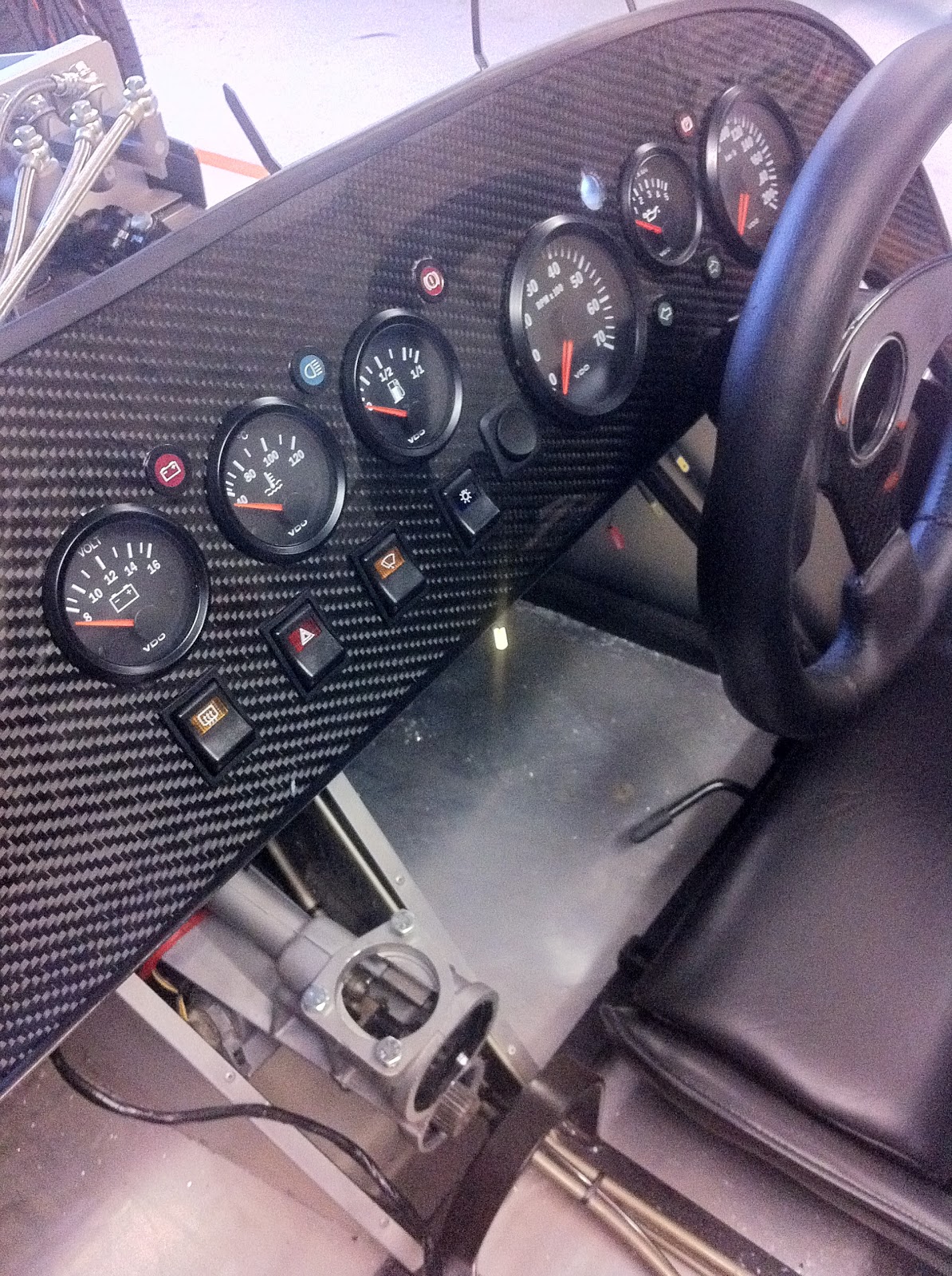
The gauges are the VDO Cockpit Vision family, and they are easily fitted with screw on backings. These came from Airco in Sydney, who are the distributor for VDO. They are well worth a visit and were very helpful and friendly. My loom was already wired for VDO gauges which made it that much easier to choose them. Visibility of the top of the speedo and tacho is an issue, so I have also purchased a Shift-I light cluster for the top of the scuttle to help with watching revs and shift points.
Tuesday, March 15, 2011
Wheels
The tyres are Toyo Proxes T1R. I opted for these over full R spec tyres until I learn how the car handles and what it feels like.
Monday, March 14, 2011
Progress so far
I realised going back over this blog that I had not published an overall photo of the progress so far. So here it is. The suspension and steering are finished. The body wiring loom is in and most of the dashboard is fitted out. All of the hydraulic reservoirs and lines are in. The seatbelts are fitted and I have one seat in for testing gauge and warning light positioning. I expect the wheels to arrive tomorrow which will allow me to drop the car off the table and then fit the motor and gearbox which is waiting patiently on the other side of the garage.
Saturday, March 5, 2011
Starting the Wiring
While I am still waiting for a few missing parts to turn up, and for the wheels to arrive I am getting as many fiddly little jobs out of the way. Today was the mounting of the wiper motor. Nothing to tricky there. Also got the dash Ground hooked up then cable tied in all the wiper motor cables and plugs so they were secure.
Main job for today was to start stripping back the donor car engine and dash looms to get the wires and connectors I need to merge with my existing body loom. The wiring is all now exposed and all the tape and flex is removed so I can begin the cutting and joining. Just doing some final checks on my wiring diagrams before I start cutting!
Tuesday, March 1, 2011
Bits and pieces
While I am still waiting for a handbrake pivot (which will unlock a whole range of build activities), I have gotten a lot of little tasks plus some shopping out of the way. I have purchased a set of VDO Cockpit Vision gauges, as my loom was already configured for these. These have been "fitted" more to see what that dash looks like, but will probably come out again before I do the switchgear and warning lights (which all need larger holes to be drilled first). I will finalise the dash loom after all the dash equipment goes in.
As the car will need seatbelts for compliance with the ADRs, I have fitted two inertia reel seat belts and buckles. This would seem like a fairly easy task, but required a fair bit of reconfiguration of the belts and some shuffling of bolts to fit. All in all that task took nearly 2 hours!
Last thing tackled today was to fit the fuel pump to the tank. The pump was supplied already modified to suit the tank and the VDO gauges by Meridian. I chose this path rather than using the factory Focus pump as this would have required extensive modifications to the tanks, and it had suffered some damage in the donor wreck. I will also have to add an external regulator and filter when I connect the fuel lines up. I made a simple gasket from cork sheet before bolting the collar down on the pump. The tank is now ready to fit once I have the diff fitted (which is all back to the missing handbrake pivot!). I have put all the handbrake cables and the handbrake in while I wait for the pivot to arrive.
As the car will need seatbelts for compliance with the ADRs, I have fitted two inertia reel seat belts and buckles. This would seem like a fairly easy task, but required a fair bit of reconfiguration of the belts and some shuffling of bolts to fit. All in all that task took nearly 2 hours!
Last thing tackled today was to fit the fuel pump to the tank. The pump was supplied already modified to suit the tank and the VDO gauges by Meridian. I chose this path rather than using the factory Focus pump as this would have required extensive modifications to the tanks, and it had suffered some damage in the donor wreck. I will also have to add an external regulator and filter when I connect the fuel lines up. I made a simple gasket from cork sheet before bolting the collar down on the pump. The tank is now ready to fit once I have the diff fitted (which is all back to the missing handbrake pivot!). I have put all the handbrake cables and the handbrake in while I wait for the pivot to arrive.
Master Cylinders
During the week, the master cylinders, reservoirs and hydraulic lines arrived. My mate Steve (Shireman on OzClubbies) put together the reservoirs and mounted them in their bracket, while I fitted the cylinders above the pedal box. A bit of wrangling with circlips and we had all the cylinders mounted. We then ran the first set of lines down to the distribution plate in the engine bay, and connected up the front and rear brake circuits. the clutch line will be finished once the engine and transmission goes in. The lines to the reservoirs will be connected once the reservoirs are mounted on the scuttle (which is currently off for wiring).
Subscribe to:
Posts (Atom)